
Concerns remain over Trews Weir repair scheme
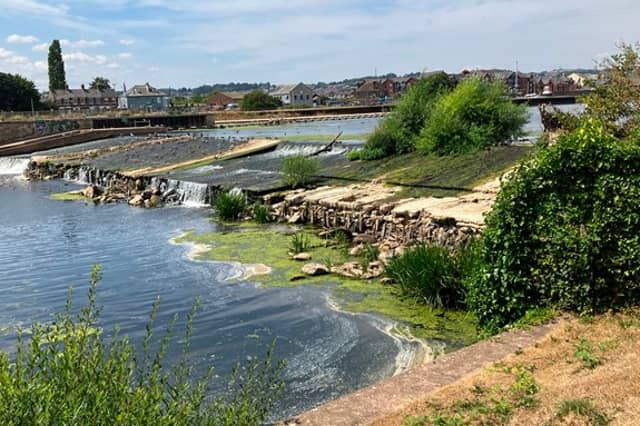

Exeter City Council says its revised plans for Trews Weir, which it acknowledges are 'narrower in scope' than the original proposals, are 'practical, deliverable, and affordable'.
There’s an increased focus on Exeter’s Trews Weir right now, a piece of vital infrastructure whose importance is probably seldom fully appreciated by those strolling past it on their riverside walks.
Originally built in the 17th Century to maintain a water level in the canal and quayside, the 72 metre long and 13 metre wide structure plays several vital roles for the city.
A history of patchwork repairs and construction materials that are failing to prevent water flowing through the core of the weir has focused minds on how to fix it.
The weir is owned by Exeter City Council, and any failure of the weir could have significant consequences for the city, including threatening the structure of the quayside and the integrity of underwater power cables supplying the city centre.
A fresh update has recently been issued by the council about a repair scheme, however, its reduced scope has been criticised by some.
And a complaint by the local Trews Weir Fisheries group has prompted a lengthy response by the council to the concerns raised in it.
Cash flow
Funding for comprehensive repairs to Trews Weir has emerged as a central issue, with the most recent update revealing hugely scaled back plans.
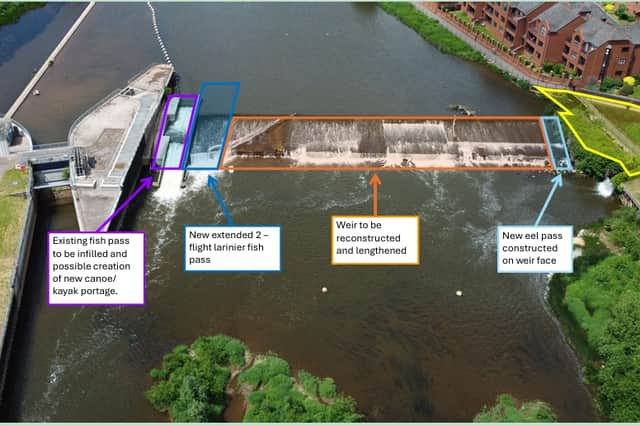
In its response to the complaint by Trews Weir Fisheries, the council’s engineering manager notes that its preferred scheme had been one it consulted the group on last summer, which would have seen “substantial reconstruction of the weir, extension of the weir toe, and relocation and replacement of the existing Larinier fish pass”.
But when high river levels occurred last winter, the way in which those repairs would have to be undertaken was reviewed, and the realisation that it would need to be done “entirely from floating plant” almost doubled predicted costs from roughly £6.6 million to £11.3 million.
That was about £5 million over the available budget.
Flood modelling predictions also suggested the infilling of the former fish pass and constructing platforms to help build a replacement pass would have reduced the available flow area of the weir and, in certain circumstances, “increasing flood risk to property”.
The city council discussed its concerns with the Environment Agency in January this year, but ultimately it couldn’t find a way of pursuing the wide-ranging repairs it had initially envisaged.
And widening the weir or replacing the fish pass where it is now – on the western side – would have “added substantial cost and complexity to a scheme that was already unaffordable”.
Even ignoring any fish pass repairs or relocations, the more comprehensive weir repairs would have had an estimated £7.4 million price tag – again outside the council’s budget.
Making waves
Exeter City Council has now revealed its revised plans for the weir, which it acknowledges are “narrower in scope” than the original proposals but are “practical, deliverable, and affordable”.
These include targeted grout or resin injection, localised surface repairs, and repair and localised reconstruction of the downstream toe wall – a barrier at the end of the slope to support the structure – with costs at just £2.8 million.
The council believes that with no change to the weir crest, there would be “no detrimental impact on flood risk”.
The scheme does not, however, include the replacement or relocation of the fish pass, which it is understood would have cost around £4.1 million alone.
The existing fish pass, and eel pass, was built by the Environment Agency in 2010, and the council has said it would support the organisation with any fish pass improvements it wishes to make.
“However, the revised scheme does propose measures intended to improve conditions for migratory fish, including the removal of an existing low wall on the weir and modifications to the bypass channel to help direct fish towards the existing fish pass,” the council stated in its recent update on Trews Weir.
Supporting wildlife that depend on the weir – particularly migratory fish – has become important, especially after low water levels – which were the initial reason the poor quality of the weir was noticed – have made it challenging for hundreds of fish, like Atlantic Salmon, to reach their upstream spawning points, leaving them vulnerable to predators.
The low water levels below Trews Weir have been exacerbated by the 2019 collapse of nearby downstream St James Weir.
Mark Walker, from Trews Weir Fisheries, said repairing Trews Weir and restoring effective fish passage were “not necessarily the same thing”, and that his group was “concerned the revised proposals could be presented as an environmental improvement without evidence that they will address the longstanding difficulties faced by migratory fish”.
“The earlier scheme included extending the downstream toe of the weir towards water level; that element is absent from the revised approach, which instead includes localised resin/epoxy repairs,” he said.
“We would welcome a clear explanation of why the original proposals changed and what technical and ecological assessments support the new approach.
“The existing Larinier fish pass is central to our concerns. We have longstanding doubts about its effectiveness, including the downstream approach conditions and the difficulties fish encounter when trying to negotiate the weir.
“We have yet to see any substantive proposal to modify or improve the pass as part of the revised works. We would welcome published evidence of how effectively it currently operates.
“Trews Weir is a significant location for migratory species on the lower Exe, including Atlantic salmon, sea trout, allis shad and lamprey. Difficulties here can affect access to habitat farther upstream.”
In on the Act
While the fish pass was built by the Environment Agency, the weir is owned by the city council.
A relatively obscure piece of legislation – the Salmon and Freshwater Fisheries Act 1975 – brings an additional dimension about responsibility.
The city council did assess whether its scaled-down proposals would “create a duty under [the Act] to replace or substantially improve the existing fish pass”.
It also noted discussions with other bodies – such as the Westcountry Rivers Trust – to potentially manage the delivery of a fish pass scheme on the Environment Agency’s behalf, but these efforts were ultimately unsuccessful.
“The council therefore does not consider that the proposed repair would prevent either replacement of the existing fish pass in situ or development of an alternative configuration in the future,” it said.
“The council continues to engage with the Environment Agency regarding proportionate improvements that can be incorporated within the current project, to ensure that relevant interfaces with a possible future fish-pass scheme are considered during detailed design, and to minimise obstacles to any future fish pass replacement which might be proposed at Trews Weir.”
There may be an ongoing legal debate here, however, over where responsibility lies in relation to the likes of migratory fish and their ability to navigate the weir.
Section 12 of the Act states an owner of a weir “shall be deemed to have altered it if it is damaged, destroyed, or allowed to fall into a state of disrepair”, although, it also relies on a repair notice being served by the Environment Agency and subsequent repairs not occurring “within a reasonable time”.
The city council has been in regular contact with the Environment Agency, and its complaint response to Mr Walker addresses the issue.
“It was identified at this time that the Salmon and Freshwater Fisheries Act 1975 would likely not place a duty on ECC to replace or significantly modify the existing Larinier Pass, so long as the weir geometry remained effectively unchanged,” it said.
“However, the designers were instructed to propose schemes which would not compromise the ability of the fish pass to be replaced or the weir modified to further improve fish passage in the future.”
Political waves
The issue of the weir has inevitably sparked political debate.
Councillor Ed Hill (Independent, Pinhoe & Mincinglake), whose Devon County Council seat is a division of Exeter, has criticised the scaled-back plans, with the proposed works expected to have a lifespan of at least 50 years – much less than the anticipated 100 years of its initial proposals.
“We are talking about critical infrastructure where structural failure could have catastrophic consequences for the River Exe, surrounding businesses, flood defences, and electricity infrastructure,” he said.
“The real concern is that Labour-led Exeter City Council is not solving the problem but simply postponing it, potentially leaving future generations to pick up a far greater bill.”
He also criticised a drop-off in consultation with interested groups, which Trews Weir Fisheries also raised in its complaint.
While the city council stated it had no statutory obligation to consult on weir repair proposals, it acknowledged it had potentially fallen short.
“The absence of a legal consultation requirement does not mean that further engagement was unnecessary,” the council said.
“Trews Weir Fishery had previously been involved in the project and had a legitimate interest in the fish-passage proposals.
“It would therefore have been good practice for the council to explain the change, the Environment Agency’s advice and the remaining opportunities for proportionate improvement directly and at an earlier stage.”
Steve Race, the MP for Exeter, said he had been in “regular contact” with the city council and the Environment Agency over the past 18 months to raise constituent concerns about the condition of Trews Weir.
“I am also meeting fishery representatives soon to discuss changes that may improve passage for migratory fish,” he said.
“In March this year and after representations I made to government, Exeter was awarded £2,863,000 of new capital spending to repair Trews Weir, on top of the £1,887,000 announced in spring 2025 – £4.75 million in total funding.
“A full replacement would be very expensive, very complex, and would take a lot longer to implement. An upgrade means the weir can instead be fixed to meet the increased risk during extreme river events more quickly,
“I am confident that this new scheme, focused on repair and stabilisation, will significantly extend the life of the existing structure quickly and cost-effectively.
“I will continue to meet with Exeter City Council, the Environment Agency, and connected constituents to make sure the proposed repair delivers the best possible outcome for Exeter.”