
Revised plans to repair Exeter’s Trews Weir are only a ‘temporary fix’, says county councillor
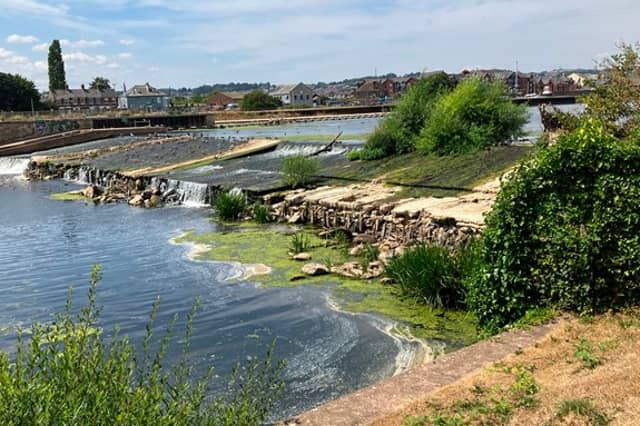

Exeter City Council has announced revisions to the original £12 million planned repair of Trews Weir, citing increased costs and technical constraints, but there are concerns the new plans do not address longstanding issues around fish passage.
Exeter City Council has announced revisions to the original £12 million planned repair of Trews Weir.
Repairs were first proposed for the weir on the River Exe after reduced water levels revealed parts of the structure, usually underwater, were in poor condition.
Trews Weir sits 500 metres downstream from Exeter Quay and serves to maintain water levels in the quay and canal. It also acts as a passage for fish, including Atlantic salmon, sea trout, and allis shad.
The cost of the original plans were estimated at £12 million. It is understood this new, “narrower” scheme is likely to cost £2 million.
Councillor Ruth Williams said the new plans were drawn up after a “number of technical and environmental constraints” had emerged.
“For various reasons, the cost of the original scheme increased from around £7 million to £12 million and even with grant funding from the Environment Agency, we didn’t have the funding to cover this significant increase,” said Councillor Williams.
“Instead, we undertook a fundamental review of the scheme and developed a revised approach focused on repairing, stabilising, and strengthening the existing weir.”
Trews Weir Fishery, an historic salmon fishery on the River Exe, has said they believe the new proposal “does not resolve longstanding concerns about effective fish passage”.
“Fish passage cannot be treated as a peripheral enhancement,” said a spokesperson for the fishery.
“It’s fundamental to the ecological outcome of publicly funded works.
“We welcome investment in essential repairs. Our objection is not to repairing Trews Weir, but to spending substantial public money on a scheme that may leave the central fish passage problem unresolved.
“We are seeking transparency over design decisions and funding constraints, [and] independent scrutiny of ecological implications.”
Exeter City Council has said it is continuing to engage with the Environment Agency, who constructed the existing fish pass, regarding fish passage through the weir.
“The revised scheme does propose measures intended to improve conditions for migratory fish, including the removal of an existing low wall on the weir and modifications to the bypass channel to help direct fish towards the existing fish pass,” said a spokesperson for Exeter City Council.
“The council will undertake stakeholder and public engagement as the detailed design develops and once proposals have reached an appropriate level of detail to enable meaningful consultation.
“Ecological considerations continue to form part of the design and consenting process, alongside ongoing discussions with the Environment Agency.”
Devon County Councillor Ed Hill has said he wants to see local organisations working together to address the issue, as he raises concerns the revised plans are a “temporary fix”.
“The River Exe is an important ecological environment supporting protected and threatened species, including the critically endangered European eel and the rare allis shad.
“We cannot continue treating the survival of these species as an afterthought.
“I want to see Exeter City Council, the Environment Agency, Natural England and our MP working together to secure funding for a permanent solution that protects the weir, the surrounding infrastructure and the wildlife that depends on the river.”