
Torquay-born pilot lands historic Spitfire at Exeter Airport following nationwide tour
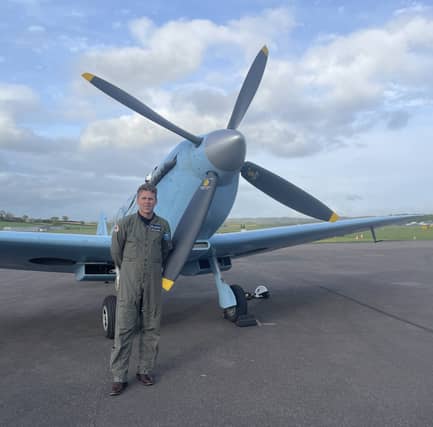

Torquay-born pilot Matt Jones has landed a historic two-seat Spitfire at Exeter Airport as part of a nationwide tour celebrating 90 years of the iconic fighter. Despite heavy weather delays across the West Country, the flight raised vital funds for the RAF Benevolent Fund and the Mark Long Trust.
A pilot born in Torquay has landed a Spitfire at Exeter Airport as part of a nationwide tour marking 90 years since the aircraft's first flight.
Matt Jones, founder and Managing Director of Spitfires.com, touched down at around 5.30pm on Thursday (April 16) after a day of delays caused by bad weather across the West Country.
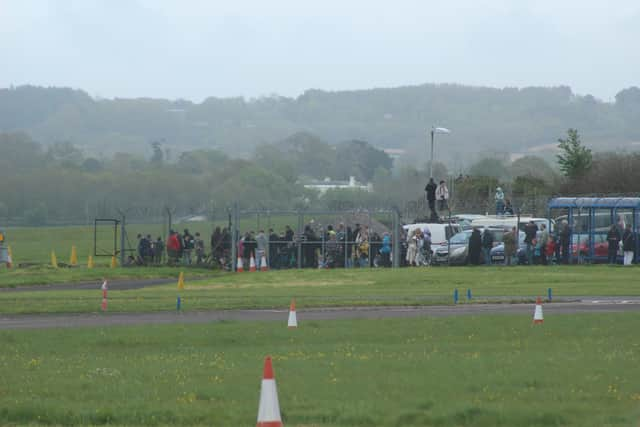
ABOVE: Crowds gathering to get a glimpse of the aircraft. Credit: Ella Sampson
The flight was the penultimate leg of a nine-stage tour being run in partnership with the Royal Air Force to commemorate the 90th anniversary of the Spitfire's maiden flight.
Matt first flew at Exeter School, where he was a member of the RAF Combined Cadet Force and trained on de Havilland Chipmunk aircraft.
After studying Civil Engineering at Newcastle University and working in investment banking in London, he returned to aviation, eventually founding Spitfires.com.
He now lives in Gittisham, a village in East Devon, with his family.
His wife and children were among those waiting at Exeter Airport on Thursday evening; the first time he had seen them in two weeks.
“Seeing them has been really magic,” he said.
The first Spitfire flight took place on 5 March 1936, when test pilot Joseph 'Mutt' Summers flew prototype K5054 from what is now Southampton Airport.
The flight lasted around eight minutes. On landing, Summers reportedly told his ground crew: “Don't change a thing.”
The aircraft became one of the most recognisable fighters of the Second World War.
This month's tour uses a civilian-owned two-seat Spitfire, painted to represent the original prototype.
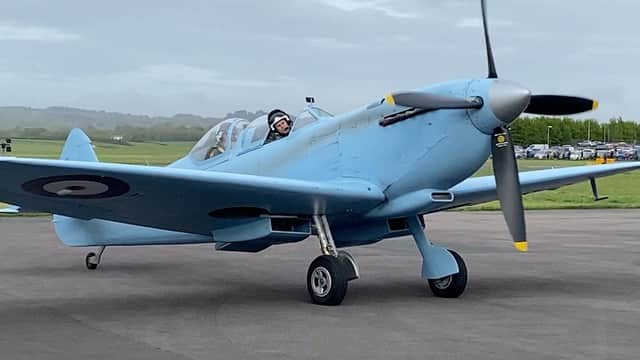
ABOVE: Matt parking the Spitfire at Exeter Airport. Credit: David FitzGerald
Members of the public bid at auction for a seat in the passenger cockpit.
Proceeds go to two charities: the Mark Long Trust, which provides opportunities for disabled people to experience flying in memory of Squadron Leader Mark Long, who died in a Spitfire accident; and the Royal Air Force Benevolent Fund, which supports serving personnel, veterans and their families with financial assistance, mobility equipment and welfare support.
Matt said the reaction at every stop had been the same.
“Airports absolutely packed, both on departure and landing each day. It just constantly reminds me how important this aeroplane is to our country.”
The aircraft was originally due at Exeter at 10.55am, having departed RAF St Mawgan in Cornwall.
Poor weather forced repeated delays and a reroute north around Dartmoor, where a planned formation flight with an RAF A400M Atlas had to be abandoned.
Instead, Matt flew the final approach into Exeter alongside a Douglas Dakota operated by the Battle of Britain Memorial Flight, piloted by Squadron Leader Paul ‘Ernie’ Wise.
The Dakota, which had flown from RAF Coningsby in Lincolnshire, joined the Spitfire for the leg along the north Somerset and Devon coastline past Minehead.
“I heard that Ernie was flying in the Dakota today,” Jones said, using Squadron Leader Wise's RAF callsign.
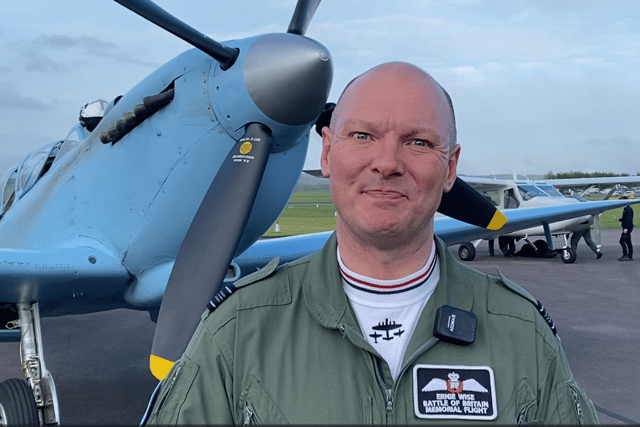
ABOVE: Squadron Leader 'Ernie' Wise flew alongside the Spitfire in the Dakota
Squadron Leader Wise said flying alongside the Spitfire on the approach into Exeter had been a privilege.
“To have it on the wing in its natural environment is truly spectacular; it's where it belongs,”he said.
“These aircraft want to be in the sky for everyone to be able to see and hear. That's part of the aim of the tour as well, to try and inspire the next generation.”
He added that the BBMF planned to depart Exeter alongside the Spitfire the following morning, heading down the south coast to Southampton for the final leg of the tour.
Squadron Leader Wise joined the RAF in 1999 and has commanded the Battle of Britain Memorial Flight since late 2025.
“A great honour”
Matt paid tribute to the wartime pilots the tour is intended to commemorate.
“I consider myself a pilot who flies a Spitfire rather than a Spitfire pilot,” he said. “The real Spitfire pilots were being shot at. But to have any association with this aeroplane is a great honour.”
The final leg of the tour was due to depart Exeter on Friday (April 17) morning.