
North Devon challenges national solar strategy to protect 'productive' fields
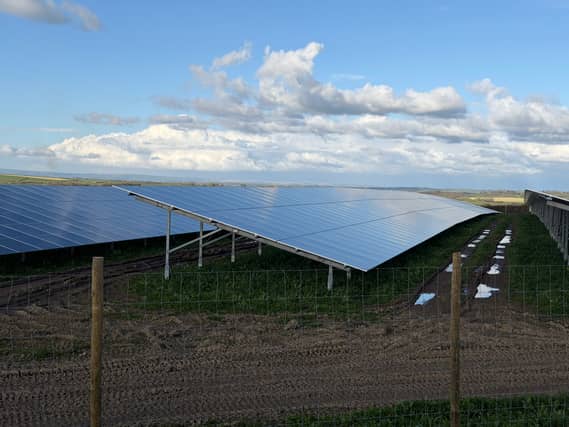

Campaigners have welcomed the move, warning that productive farmland is increasingly being targeted for energy projects
North Devon Council has signaled a major shift in its green energy policy, voting to prioritise solar panels on rooftops and car parks over large-scale 'solar farms' on local fields.
The vote prioritises the protection of local farmland by directing solar development toward surfaces such as rooftops and car parks. Under the new strategy, the council also wants larger solar arrays to be restricted to previously developed brownfield sites rather than being built on greenfield land.
The motion, proposed by Cllr Pru Maskell, called on the government to develop policies to support these priorities and provide financial incentives for rooftop and car park solar projects.
While the decision has been welcomed by campaigners, it also raises broader questions about the balance between renewable energy expansion and food production in rural areas like North Devon.
The debate in North Devon comes as the government pushes toward its ‘Clean Power 2030’ target, which aims to meet the UK’s total electricity demand using clean sources by the end of the decade.
While low-carbon sources currently provide roughly 64 per cent of the nation’s electricity, the Department for Energy Security and Net Zero (DESNZ) has recently overhauled planning rules to ‘unblock the grid’ and accelerate new infrastructure.
Energy Minister Michael Shanks has defended the necessity of large-scale sites, such as the Springwell Solar Farm in Lincolnshire.
Approved on April 8, the project will become the UK’s largest solar farm, covering 1,280 hectares (3,163 acres) of agricultural land, an area equivalent to roughly 1,700 football pitches.
Mr Shanks argued that such projects are essential for ‘securing our own energy independence’ and providing cheaper power, even as rural councils prioritise different land-use strategies.
In North Devon, environmental group, the Campaign to Protect Rural England (CPRE), said the council’s stance reflects growing concern about the scale of solar developments being proposed across the county.
Steve Crowther, chairman of Devon CPRE, said large solar farms risk taking valuable agricultural land out of use at a time when food security is becoming increasingly important.
He said: “This is a very welcome and timely move by North Devon, as investors are lining up to create large-scale solar installations in several parts of the country.
“We sincerely hope that other district councils will follow suit and send a clear message to the speculators that they are not welcome on our green land.”
In North Devon and Torridge, proposals for major solar developments have already begun to emerge, including sites near Holsworthy and Alverdiscott, which have prompted local opposition.
The debate reflects a growing tension seen across rural communities - how to meet climate targets while preserving landscapes and agricultural capacity.
North Devon Council’s position does not amount to an outright ban on solar farms, but it signals a preference to where future developments should be located.
The Gazette has contacted North Devon Council for further comment.