
Photo by Simon Cheung on Unsplash
Search


21 Jan 2026

Please allow ads as they help fund our trusted local news content.
Kindly add us to your ad blocker whitelist.
If you want further access to Ireland's best local journalism, consider contributing and/or subscribing to our free daily Newsletter .
Support our mission and join our community now.
To continue reading this article, you can subscribe for as little as €0.50 per week which will also give you access to all of our premium content and archived articles!
Alternatively, you can pay €0.50 per article, capped at €1 per day.
Thank you for supporting Ireland's best local journalism!

David Walsh and Steve Darling at the Rock Garden
Business leaders and MPs in Torbay have united to send out a desperate plea to the government - please Save Our Businesses.
They fear that with a string of suffocating policies from the powers-that-be in Westminster, businesses in the Bay, especially in the tourism and hospitality sector, are on their knees and calling for help before it’s too late.
Anthony Jones, who owns Otto and Twenty1 Lounge bistro and restaurants on Torquay harbourside, is also chair of the Torquay Independent Business Owners Group, which represents the interests of dozens of businesses in and around the harbour and waterfront.
He has penned an open letter to Ministers highlighting the growing concerns of his industry and the Bay.
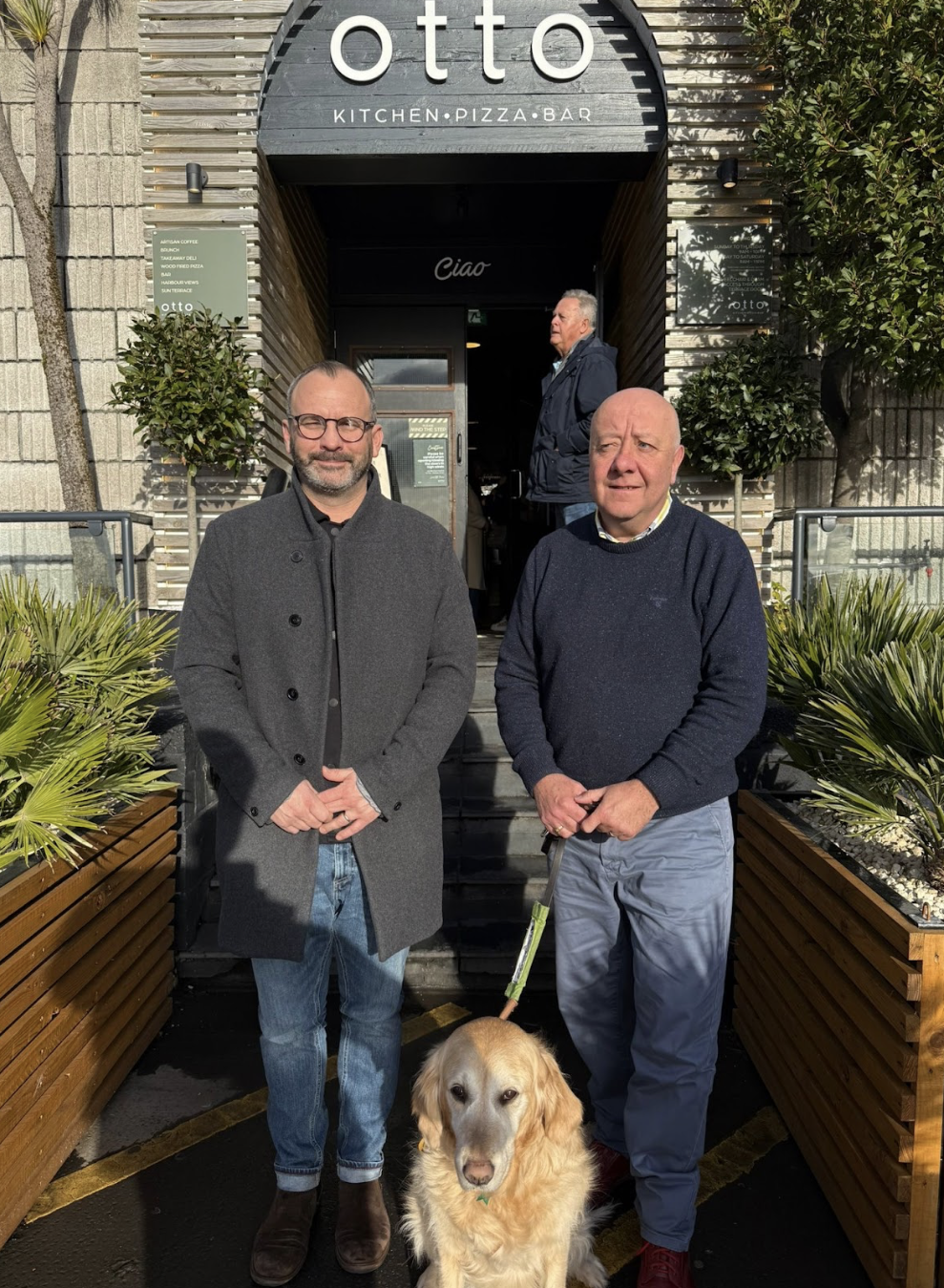 Anthony Jones and Steve Darling at Ottos
READ NEXT: South Devon MPs raise local hospitality crisis in Commons debate
The letter has been handed to Ministers by Torbay MP Steve Darling who, together with Lib Dem ally, South Devon MP Caroline Voaden, has been fighting the Bay’s corner in the House of Commons.
Mr Jones revealed he had met MP Darling to discuss all the rising costs and issues facing the hospitality sector as a whole.
“I have put pen to paper and written an open letter from myself with the support of the TIBO team wording a collective opinion on the realistic dire economic situation most of us have found ourselves in at the start of 2026,” said Mr Jones.
“The letter has been written from the heart. Torbay is 90 per cent independently operated and we are all predicting another tough year of trade.”
Mr Jones writes in his open letter:
Securing the Future of South West Independent Hospitality (2026) - A Sector at Breaking Point
As of early 2026, the South West hospitality sector remains a vital part of the regional and national economy. But behind the postcard image of thriving staycations lies a far more fragile and alarming reality.
Independent hospitality in the South West is not powered by corporations. It is powered by families. Families who live above their pubs. Families who raised their children in B&Bs.
Families who have poured their life savings, their health, and their futures into serving their communities and welcoming visitors.
For thousands of young people - especially those who struggle in traditional academic settings or unstable home environments - hospitality is not just a job. It is a second home, a first chance, a place to learn discipline, confidence, responsibility, and pride.
Yet today, this entire ecosystem is being slowly and relentlessly crushed by cumulative government policy.
If nothing changes, we will without doubt see accelerating closures — not because owners have failed, but because there will be nothing left to give. No margin. No resilience. No way to support both the business and their own family home.
This is not a theoretical risk. This is happening now.
The South West’s hospitality industry is uniquely dependent on seasonal, part-time and entry-level workers — often young people taking their very first steps into employment.
With the employer National Insurance rate now at 15 per cent and a lowered secondary threshold, the cost of employing local people has surged.
For a family business, this is not absorbed by profits.. It is absorbed by fewer staff, shorter opening hours, owners working 70 to 90 hour weeks or simply giving up. Every additional tax on jobs is, in reality, a tax on opportunity.
Requested Action
An immediate expansion of the Employment Allowance specifically for independent firms with turnover under £2 million.
This is not a loophole. It is a lifeline for the entry-level job market that keeps young people in Devon, Cornwall, and Somerset working, learning, and off the margins of society.
In basic terms the PAYE monthly bill is another silent killer, we need further support with this to reduce this additional cost. Urgent reform is needed here if you want to see the next generation of hospitality workers and business owners.
Alongside higher wage costs and National Insurance costs reforms around zero-hour contracts, day one sick pay, and day one unfair dismissal rights all increase costs and risk at point of hiring.
For seasonal businesses this makes it harder to take on entry level and young staff, where demand can fluctuate week to week and we need to drive efficiencies once the summer season ends.
These challenges are almost impossible for smaller independent operators to manage, particularly those without dedicated HR teams to ensure compliance is handled correctly.
The UK remains an international outlier with 20 per cent VAT on hospitality — effectively a permanent “tourism tax” on British seaside and rural communities.
Independent venues are being crushed between unstable food prices, volatile energy costs, rising wages and an immovable VAT burden
They are not passing this on. They are absorbing it until they break.
Requested Action
A permanent VAT reduction structured as 12.5 per cent in Year One as an immediate lifeline, then 15 per cent from Year Two onwards - applied to all food sales, non-alcoholic drinks, accommodation.
This is the single most powerful lever government can pull to restore cash flow, enable reinvestment, support “Green Tourism” upgrades and stop the bleeding of closures
Without this, the decline will continue — quietly, steadily, and irreversibly.
The new “Tiered Multiplier” system is welcome. But the 2026 revaluation risks becoming a mass extinction event for independents in tourist areas. Rateable Values in ‘desirable’ South West locations — based on 2024 trading conditions that no longer exist — are forcing huge increases on businesses that are already exhausted.
These are not ‘prime assets’, they are people’s lives and homes.
Requested Action
A Regional Transitional Relief Cap: no independent operator should face more than a 5 per cent increase per year.
Levels have gone from 75 per cent discount to 40 per cent for hospitality, a fix of five years at 50 per cent would allow for planning and stability in the sector and allow business owners to plan better financially.
The National Living Wage increase to £12.71 (and £10.85 for 18–20s) is morally understandable — but economically explosive for a region with a young workforce and highly seasonal demand.
This is not being funded by shareholders. It is being funded by owners not paying themselves, families burning through savings, deferred maintenance or closure
Requested Action
A temporary freeze on further wage increases for 16–20 year olds
A shift in policy focus toward supporting businesses that employ and train young people properly — building real-world skills, confidence, and work ethic
Do not force employers to replace young people with technology, automation, or shortcuts.
Give young people purpose, not redundancy.
This approach allows small teams to survive without destroying service quality — and without destroying the people who run them.
The Core Truth
Independent hospitality is not just a sector.
It is social infrastructure. It trains young people, sustains families, anchors towns and villages and gives Britain its character
Right now, policy is breaking it faster than it can heal.
If this continues, we will not just lose businesses. We will lose family homes, careers, communities and an entire generation’s first step into work
A Final Appeal
Hospitality is currently the third largest employer in the UK, supporting around 3.5 million jobs when direct and indirect employment is included.
The decisions made in the coming months will affect millions of real people — not statistics. We are not asking for handouts, we are simply asking to give us HOPE. Small changes to all the above policies would give the industry just this.
You are elected by the people of these towns and communities.
And right now, we need you more than ever to fight not only for us, but for the future of the entire industry.
These words are being echoed by thousands of independent business owners across the country. nThey deserve to be heard.
Now is the time to act. We are standing together, speaking out, and asking — sincerely — for your support to work with us, not against us.

Subscribe or register today to discover more from DonegalLive.ie
Buy the e-paper of the Donegal Democrat, Donegal People's Press, Donegal Post and Inish Times here for instant access to Donegal's premier news titles.
Keep up with the latest news from Donegal with our daily newsletter featuring the most important stories of the day delivered to your inbox every evening at 5pm.