
Emergency crews in attendance. Credit: Submitted
Search


23 Mar 2026

Please allow ads as they help fund our trusted local news content.
Kindly add us to your ad blocker whitelist.
If you want further access to Ireland's best local journalism, consider contributing and/or subscribing to our free daily Newsletter .
Support our mission and join our community now.
To continue reading this article, you can subscribe for as little as €0.50 per week which will also give you access to all of our premium content and archived articles!
Alternatively, you can pay €0.50 per article, capped at €1 per day.
Thank you for supporting Ireland's best local journalism!

David and Karen Fitzgerald with their son George, whose DNA helped develop the life-saving meningitis B vaccine following his 2000 diagnosis. (Image credit: ITV)

Christmas of 2000 will stay in my family’s memory for the rest of our lives.
The current outbreak of meningitis and its vital news coverage has brought back a period which we hoped we would not have to relive, but it has inspired us to try and get the message across that this disease is always in the community and to check and double check for symptoms.
A short while ago, we agreed to appear on ITV Westcountry to tell the story of our son George.
In that Christmas period, he had become ill after a fall, a cold, we were told by the doctor, who was not happy to have been called out at that time of year.
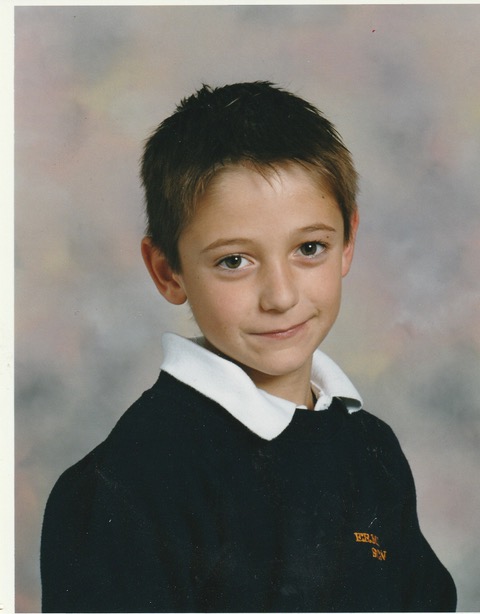
ABOVE: A school portrait of George Fitzgerald, whose DNA contributed to the development of the Meningococcal B vaccine. (Image credit: David Fitzgerald)
George did not get any better and the ‘cold’ diagnosis did not sit well with my wife who took him to A&E only to be reassured that colds were commonplace at that time of year.
On Christmas Day, a locum doctor came to the house and suggested that we ‘blue light’ him to the hospital, better still, drive him now… quickly. I carried him to the car and broke several laws getting him into a ward.
He was ill, but again was not actually showing any great deterioration and certainly not the full meningitis symptoms. After
what seemed an eternity, it was suggested that a lumber puncture be taken, something I never want to see again.
George was held down forcibly as if he moved with a needle in his spine; it could have serious life-changing consequences.
Karen, my wife, remembers a small tear running down his face as the needle went in, but as the fluid came out, we all knew that there were a few more tears to come. The liquid was cloudy, which could only mean one thing.
George was scooped up and taken to a specialist ward, the team actually running with this still conscious but confused very ill child. The remarkable treatment started.
We were warned that the results were hanging in the wind. When my wife asked what the worst case scenario was,
the answer was bluntly… he had between eight to twelve hours to live.
The NHS saved his life, but questions were still being raised as to how he could have survived for five days without antibiotics, and not only that, how he walked away relatively unscathed by this disgusting disease.
At the time Sheffield University were trying to develop a vaccine against Meningococcal B Meningitis, and we were asked if they could take samples and use his DNA as part of the investigation and development of a vaccine.
We of course, said yes and were promised that within 10 years there would be a breakthrough. I must admit that I forgot about this promise and we, as a family, got on with our lives. But 10 years, more or less to the day, a letter arrived to
thank George for his valuable input, a vaccine had been developed with his help, and it is that vaccine that is being used today to combat this outbreak.
The ITV news feature included our plea to be vigilant and double check if you have any suspicions. George did not show a rash or lose his mobility. The locum and a mother’s love and dedication got him to hospital, and the NHS simply did the rest
without question.

Subscribe or register today to discover more from DonegalLive.ie
Buy the e-paper of the Donegal Democrat, Donegal People's Press, Donegal Post and Inish Times here for instant access to Donegal's premier news titles.
Keep up with the latest news from Donegal with our daily newsletter featuring the most important stories of the day delivered to your inbox every evening at 5pm.