
North Devon student will lead scientific expedition to 21,000 feet in the Andes


A Barnstaple student from Sheffield University is leading a team to the Laguna Glacier high up in the Bolivian Andes this summer
A Barnstaple student is set to lead a challenging expedition to the Bolivian Andes this July to study the effects of climate change on a live high altitude glacier.
Stanley Sherlock and his friends from the University of Sheffield, Joe Sparks and Millie Chettleborough, will spend around three weeks on the ice of the Laguna Glacier at up to 21,000 feet in the Andes mountains.
The trip has been made possible thanks to a Royal Geographical Society (RGS) Explore Grant and a grant from the Jeremy Willson Charitable Trust. The three-strong team of undergraduate students will be working with students from the San Andreas Higher University in La Paz.
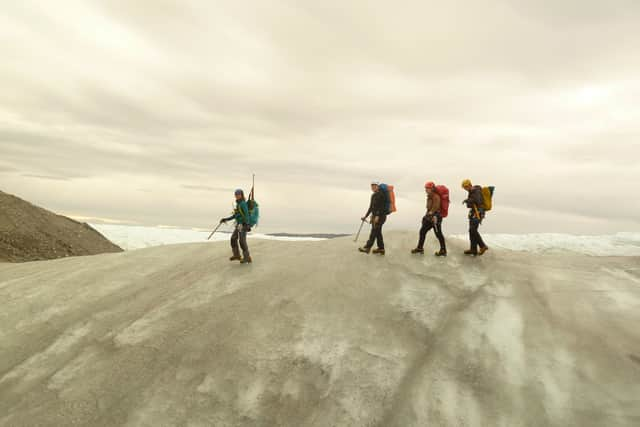
Above: Trekking across a Greenland glacier – the researchers had to do daily trips of many kilometres to reach their study sites. Credit: Stan Sherlock
While no stranger to ice, working at high altitude will be a new experience, with the team regularly working at 18,000 feet and up to 21,000. The Gazette caught up with Stan to hear more about the trip and his passion for glaciers, research and the environment.
He said: “Glaciers are amazing, there’s a human fascination for ice and even for that value alone they have great worth, but a lot of things threaten them.
“The data we intend to gather will build a temperature index model and forecast climate change scenarios as to how the glaciers might be affected or diminished. High altitude glaciers in particular are a good indicator of how it is affecting the environment.
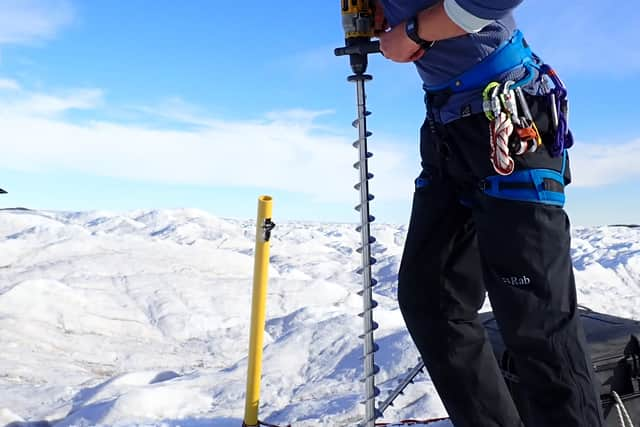
Above: A researcher drilling into the ice on the Greenland glacier. Credit: Stan Sherlock
Stan went on: “My friend Millie, who I am working with on this, provided a risk assessment and summed it up with ‘many ways to die’.
“There are crevasses, but I think the greatest risk is long term high altitude, which will be physiologically demanding doing strenuous activities every day and heading on to the glacier most days for three weeks will be really demanding.
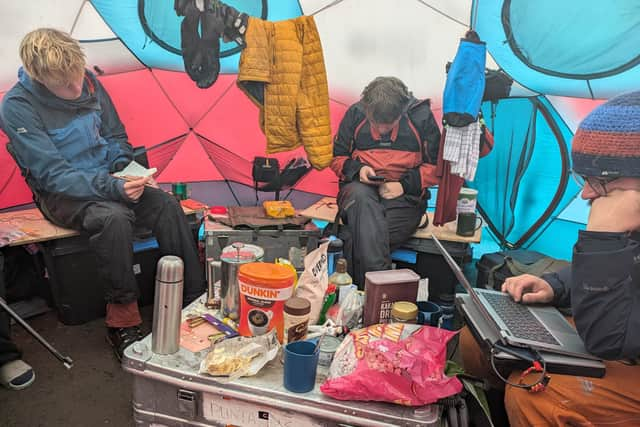
Above: Stan, left, at camp in Greenland last year. Credit: Stan Sherlock
It is a far cry from his voluntary work with Barnstaple-in Bloom, but various paths and experiences will have led directly to standing on an Andes glacier in a few months’ time.
Stan was born and bred in North Devon – born in a toilet in Barnstaple in fact! He attended Newport primary School and then the Park School. He went on to Petroc to study engineering.
He also worked a number of part time jobs, before ending up at St John’s Garden Centre, where he became interested in horticulture and that led to him meeting Frances Bell of Barnstaple-in-Bloom.
He said: “I used to pass the memorial gardens area in town and would imagine alternative planting schemes for it, so I spoke to Frances. A budget was available and so we redesigned it and planted the beds around the memorial garden as well as an Alpine bed in Rock Park.”
He already works part time as a teacher during his studies at university, as well as at a summer camp in America and is keen to go into teaching while continuing active fieldwork in remote locations.
He added: “I could see myself pursuing a career in glaciological research. I think if I pursue glaciology, there could be some exciting fieldwork. My primary motivation for studying it was as a way to mitigate climate change.
“Although research is good, I think it’s more important that we forge more connections with young people, the environment and understanding climate change.
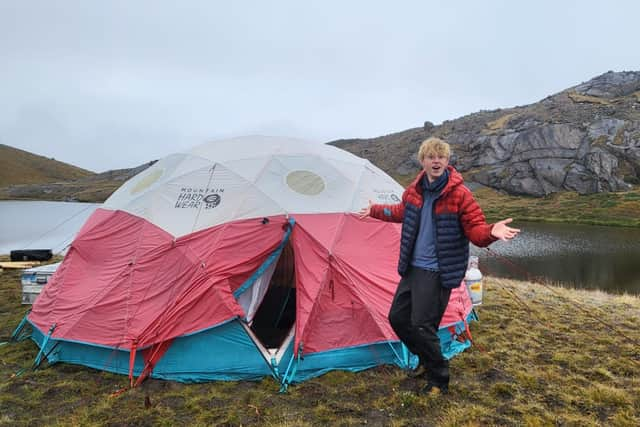
Above: Stan said he loved every minute of the trip to Greenland and is keen to travel up to 21,000 feet into the Andes mountains this July. Credit: Stan Sherlock
Determined to get as much out if university as possible, he signed up to the Greenland trip last year and loved every minute of it.
He said: “It was just vast expanses of ice; I was enthralled by it all. I was just an apprentice to these amazing people and I learned so much.
“The research was really exciting but just learning about the glacier environment, that was eye-opening. But I could also see how the glacier ice sheet was suffering and it felt as if it was deteriorating, it felt very much alive.
“That was my third time ever on a glacier but my first time spending long term on the ice of a glacier. Greenland has lots of tundra; it’s very diverse, with caribou and predatory birds. Most of the landmass is a massive sheet of ice. During summer, it’s just glacial ice and the air is actually quite warm.
“I loved all of it. It’s really hard going though. I remember one day we walked to a data station and back, it was a 30km around trip, walking on the tundra, over a mountain and then walking on the glacier itself for about six or seven kilometres.
“It was more tiring than I expected, but it was so interesting, being in a glacier environment - I had never really comprehended one before outside of text books or movies.”
There will be plenty of ice this time too! The trip is expected to run between July 1 and 29.
Stan thanked the RGS for and the Jeremy Willson Charitable Trust funding and supporting the trip. The RGS offers a variety of grants, including those for students, teachers, independent travellers and academics.
He added: “I would also like to thank academics (and the rest) at the University of Sheffield, plus our collaborators at San Andreas Higher University including Marcos, Juan and Abigail.
“Plus thank you to Buffalo Systems, Clara Stockdill, friends from St John’s and Barnstaple in Bloom including Norma, Lewis and Francis Bell and of course, Joe and Millie.”