
Behind the scenes with North Devon’s longest serving RNLI lifeguard


As part of the RNLI Lifeguards 25th anniversary, the Gazette caught up with area supervisor and the region’s longest serving active lifeguard Matt Whitley to find out what it really means to save lives on local beaches
As the RNLI Lifeguard service marks its 25th anniversary this year, North Devon’s lifeguard team have spent a busy few weeks gearing up for the new season.
To mark the anniversary and to find out what it really means to be an RNLI lifeguard, the North Devon Gazette is launching a series of features to look behind the scenes at the work these lifesavers do.
The RNLI lifeguards have already returned to Croyde and Woolacombe beaches full time and from Saturday, May 16 a full daily service will also begin at Westward Ho! and Sandymere beaches.
We visited ‘lifeguard HQ’ at Mullacott near Ilfracombe to chat to Matthew Whitley, lead lifeguard supervisor and North Devon’s longest serving active lifeguard, with 23 years of lifesaving under his belt and almost 20 of those in North Devon.
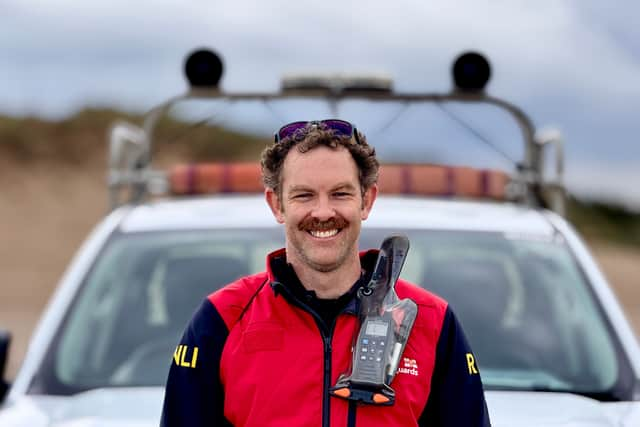
Above: Matthew Whitley is the lead RNLI Lifeguard supervisor for North Devon, Torridge and parts of Somerset. Credit: RNLI
He has seen more than his fair share of rescues while both on and off duty and is heavily involved with Croyde Surf Lifesaving Club, where alongside the roles of safety officer and chair, he trains the club ‘nippers’ and potentially the next generation of lifeguards.
In fact, training is the most important part of the service and while July beachgoers are always reassured to see the familiar RNLI Lifeguard truck and alert teams on the beach, they might not appreciate those teams began their training for the season back in the chilly depths of mid-March.
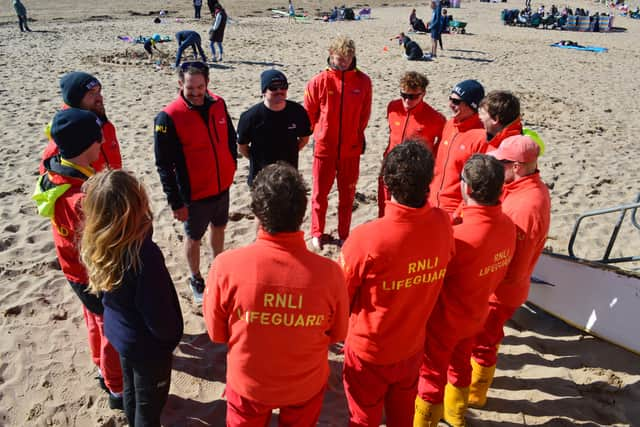
Above: Some of North Devon’s RNLI Lifeguards receive a briefing from lead supervisor Matt Whitley. Credit: RNLI
The initial selection process is very stringent too and the RNLI only recruits from a pool of already-qualified lifeguards, as Matt explained: “We know that lifeguards who are coming into the team locally have their own lifeguard qualification, that they've got through a surf lifesaving club, or they've got through a private provider.
“So that is somebody who has already had done 40 hours of training and has their basic first aid skills and basic rescue skills, but we test them through the recruitment process.
“Not only have they got those 40 hours, but they've got to be swimming for quite a few years before that and in the water, especially our local beaches with the surf, knowing those beaches well and be comfortable in the water.”
The recruits all have to complete a ‘basic’ fitness test, which includes a 400 metre swim in less than seven minutes 30 seconds, swimming a length underwater, a 200m beach run and various rescue scenarios.
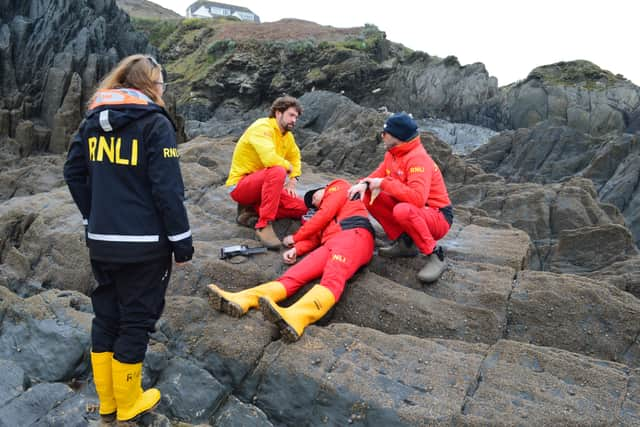
Above: RNLI Lifeguards constantly practice a range of training scenarios and are pictured here at Woolacombe during a simulated rescue of a casualty injured on the rocks. Credit: RNLI
North Devon has a long history of surf-lifesaving, with local police and surfers starting their own patrols on beaches as early as 1960, following too many deaths by drowning.
While the RNLI set up its lifeguard service 25 years ago in Cornwall due to a need for more cover, the service did not arrive at Westward Ho! until 2005 and was rolled out to the rest of the local beaches a year later.
Matt has been a lifeguard in North Devon for almost all of it – he grew up in Whitsand Bay in Cornwall and became a lifeguard in 2003 because his older brother was one.
He said: “I was into surfing and the lifestyle and decided it was a good summer job through university. Using my water skills and enjoying being in the best office in the world, really, on the beach.”
The opportunity arose to lifeguard in New Zealand as part of an RNLI exchange scheme over the winter of 2006-7, then Matt decided North Devon’s golden beaches were where he wanted to be and he has never left.
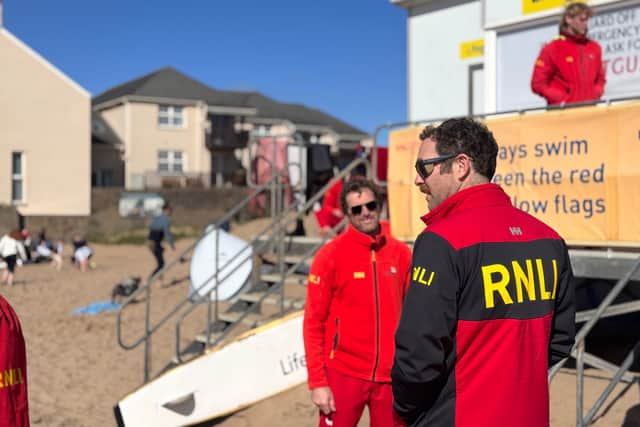
Above: Matt Whitley has worked as a lifeguard on North Devon beaches almost since the service began in the region. Credit: RNLI
In 2009 the opportunity came up to be a lifeguard supervisor and Matt jumped at the chance and has held the management role for the area since 2019.
He went on: “Coming to North Devon was an eye-opener with the volume of people that come onto the beaches here. You can get anything from six, seven, to 10,000 people a day and there's a team of six to eight lifeguards, keeping that safe, that's a one to a 1,000 ratio.
“Woolacombe did 200 rescues last year, Croyde did the same and Croyde can even have up to 400 rescues in a year.
“It's a career I never knew I was going to have, but a career that I've loved and I still love it and I've got two sons who are nine and 12 who, they're turning out potentially to be the lifeguards of the future as well.
“In one way, the role of a lifeguard on the beach in this country, in another country, even in a swimming pool, is still the role of a lifeguard, and in that case, things haven't changed.
“You're there to educate, prevent and use your skills of the water and knowledge of the beach to make sure people are safe. So there's a very core heart of things, which I remember in my first rescue and my first day on my beach with my older brother, who told me what to do and that’s still what I'd instruct the lifeguards of the day to do on their first day, you can't get away from that.
“What I have seen change, which I've been benefitted from with a career, is the profession as in of what that service is in terms of the knowledge, the skills, what the lifeguards develop in their time working for us and the and the expectation of what we provide to the public is so much more professional.”
Matt said one big change was how lifeguards were perceived, these days seen as a professional group by the public and considered a worthy career by parents or young people to go into.
He added: “People expect lifeguards to be on the beach. They expect to be helped and they really respect that as well.
“When I started lifeguarding, it was different. We probably didn't run as professionally as we do today with the procedures and the rules and the knowledge to keep ourselves safe while working.
“After 20 years of being involved in lifeguarding, all the lifeguards who have come through, it’s been great seeing how they’ve taken their careers onwards.
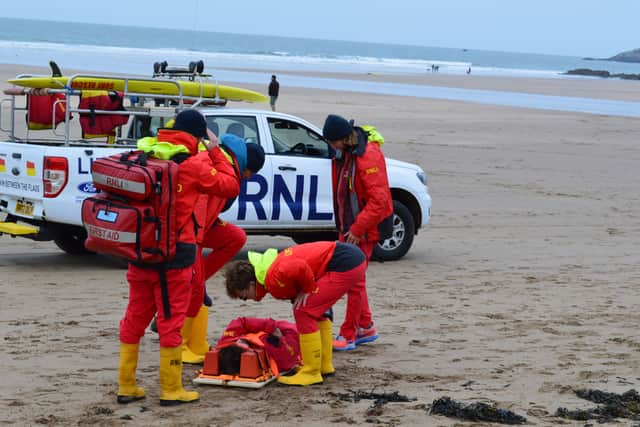
Above: Training for casualty care and extraction during an exercise on Woolacombe beach. Credit: RNLI
While the core skills and equipment such as rescue tubes, personal watercraft and inshore rescue boats has remained about the same, Matt said there had been great improvements in casualty care and first aid with the help of new technology and techniques.
But he said the real changes had come through training, incident and beach management, with the service learning a huge amount in the past two decades and from the many incidents it has attended.
Of those incidents, a few stick out in his memory, including his first ever rescue aged 18. He said: “I was sat on a quiet beach in Cornwall and there was two kids in the water and then I heard them screaming.
“I was there with a tube and I remember swimming out and getting them and that was the first one - if I hadn't been there, they would have been a lot of trouble.”
In 2008, he and the North Devon team made headlines when they rescued upwards of 40 people within 20 minutes when conditions changed suddenly.
Matt and a female colleague were out on paddle boards trying to keep swimmers and surfers safe while offering advice, when the sea’s mood turned ugly and people began to drift out of their depth.
He said: “You just realise the conditions are changing that quickly, that you can't physically get to them all and then another lifeguard came down, they swapped over, they got the boat out and before I know, I've got five people hanging on a rescue board and the boat is ferrying them in and out.
“As soon as you get two people on the beach, then you have to go get the next ones. Those are not common occurrence, but they can occur.”
Responding to a non-breathing casualty is one of the most serious situations a lifeguard can face and Matt reflected on successfully resuscitating a casualty: “It was in 2014 and I remember quite vividly because we had two people dragged out the water at the same time, both unconscious, not breathing.
“I was on a seven-year-old boy and that's a bit of a shock, but all the training and the support kind of kicks in. I was experienced as a lifeguard, but there were some new lifeguards too, one of them, she's now a paramedic, which is amazing to hear.
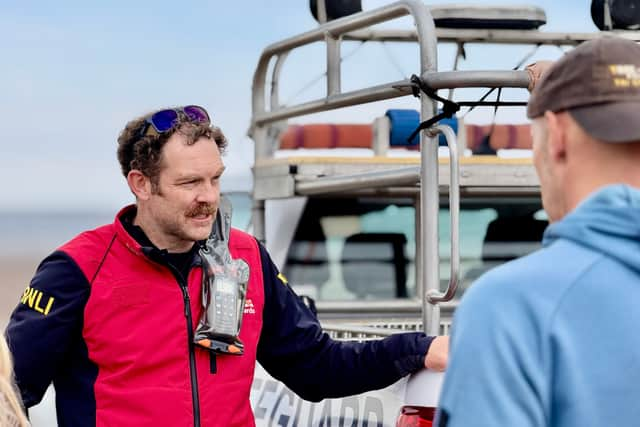
Above: Matt working at Croyde beach. Credit: RNLI
More recently, two years ago he was taking a group of more experienced surf lifesaving ‘nippers’ through the gullies at Croyde on a training run before work, when they came across two young holidaymaker boys hanging onto a single bodyboard.
Matt recalled: “The leash for the board was wrapped around both their necks and they were struggling to keep their head above water.
“I was there right place and time with a rescue board with a group of kids, so I had to kind of manage my own group, keep them safe by making sure they were okay in the surf.
“But I was just happy to be there when both of those boys were getting into trouble and managed to get them both on the rescue board and surf them in.
Above: If the surf is big this summer, it's good to know the RNLI Lifeguards are on hand in case anything does go wrong. Credit: RNLI