Search


07 Mar 2026
Search
07 Mar 2026

Please allow ads as they help fund our trusted local news content.
Kindly add us to your ad blocker whitelist.
If you want further access to Ireland's best local journalism, consider contributing and/or subscribing to our free daily Newsletter .
Support our mission and join our community now.
To continue reading this article, you can subscribe for as little as €0.50 per week which will also give you access to all of our premium content and archived articles!
Alternatively, you can pay €0.50 per article, capped at €1 per day.
Thank you for supporting Ireland's best local journalism!

(Photo courtesy of: Sergei Piunninen on Unsplash)
Paignton’s history goes back to Saxon England and quite possibly earlier than that.
An inland settlement based around the Church Street and Winner Street area, it was generally a farming community and the land between this and the sea was marshland.
In some areas the sea was known to extend much further inland than it does now and an example of this is Fisher Street, which at one time was at the water’s edge. Likewise, both Brixham and Torquay were known to have small Saxon settlements recorded in the Doomsday Book.
The Anglo Saxons started to arrive in the seventh century. They came from Germany, Holland and Denmark and were generally a peaceful people, unlike the Romans who preceded them and the Vikings who followed.
A group of Anglo Saxons made their way to Paignton, liked what they saw and decided to stay. The leader of the group was Paega and it is believed that derivations of this name led to the spelling of Paignton as we know it today.
The Anglo Saxons were Christians and built a wooden church on the site of the present parish church. We know this to be true as workmen digging trenches to carry out drainage work discovered the post holes which held the struts for the roof.
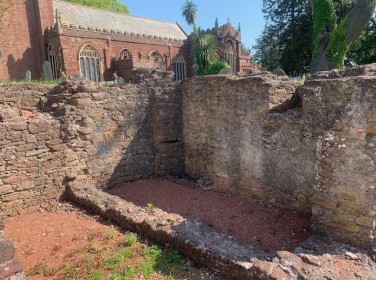 The remains of the travellers accommodation in the Bishops Palace, The garderobe can be seen in the corner of the ruin
Life continued in the agricultural hamlet of Paega’s people, the soil was good and there was a plentiful supply of fresh water from a spring in what is now Well Street. In the eighth century the Vikings invaded England from the North, very different from the peaceful Saxons; they were cruel and aggressive people who terrified the local inhabitants.
The nearest they came to Paignton was probably Exeter. Traces of the Vikings have also been found in Tavistock but life continued in much the same way here until the arrival of the Normans in 1066.
Having defeated the Saxon King Harold at the battle of Hastings in 1066, William of Normandy was crowned King William 1st at Westminster cathedral on December 25 1066.
He set about installing some order and structure into his new kingdom and commissioned the compiling of what we now call the Doomsday Book.
This book listed the number of people and livestock in every settlement in William’s kingdom. The book took only a year to complete. Paignton was listed as having 52 villagers, 40 smallholders, 36 slaves and five others. Women and children were not counted or recorded in the Doomsday book and it is likely that the village of Paignton had around 500 inhabitants.
The area in and around Paignton was owned by the Saxon Bishop of Exeter Leofric before the conquest but later passed to the Norman Bishop Osbern.
The Bishop’s main residence was in Exeter but having taken a liking to the area of Paignton it was decided that a summer palace should be built here for the bishop. Very little of the building remains, just a small area of ruins at the back of the churchyard facing on to Palace Place.
The Church had a duty to house and feed travellers and it is thought that the ruins are possibly the remains of travellers accommodation.
In the corner can be seen the ruin of an early garderobe, a small room , not much bigger than a cupboard, with just a hole in the floor for human waste to travel down to the gutter, not up to today's health and safety standards but a useful facility at the time.
The local population grew slowly and a community of Monks arrived and set to work. The stream was dammed and a mill pond was constructed together with a mill.
Here the monks worked grinding corn into flour and helping to feed the villagers. The influence of the church grew and the area thrived.
In 1295 Edward I granted a charter to allow the villagers to have a weekly market, Edward I was involved in many conflicts and by allowing the town to hold a market he was able to levy more taxes and raise the revenue he needed. The King was not the only beneficiary however as the weekly market boosted the economy of the village and benefited the population.
In the late 1300s Kirkham House was constructed . Still standing today it is an excellent example of a high-status medieval building. Almost certainly built by the church, it is believed that Kirkham House was probably an administration building rather than a place of worship.
Containing many fascinating original features Kirkham House is well worth a visit and will be open to the public on Good Friday for the first time in 2026.
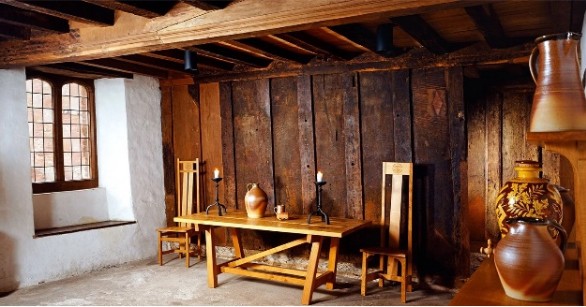 One of the rooms inside Kirkham House. A very fine example of a medieval wooden screen can be seen in the picture.
Paignton Heritage Society opens Kirkham House and provides guided tours on behalf of English Heritage. The house is open on bank holidays and Sundays in July and August.
PHS has an extensive archive of historical documents, books and maps in the Heritage room in the library. Open on Mondays Thursdays and Saturdays from 11am to 3pm, a team of knowledgeable and helpful volunteers are available to help visitors with questions and enquiries.
Our website has been re-designed and has a wealth of information about Paignton from pre-historic times to the present day, definitely worth a look.
Monthly meetings are held on the third Thursday of the month. Our next meeting is on January 15 at Gerston Chapel in Torquay Road, Paignton at 7pm. Our speaker will be Richard Hunt and his subject is the story of Hunts Devon Cider.
Entry is £5 (£4 to PHS members) and includes tea and coffee.

Subscribe or register today to discover more from DonegalLive.ie
Buy the e-paper of the Donegal Democrat, Donegal People's Press, Donegal Post and Inish Times here for instant access to Donegal's premier news titles.
Keep up with the latest news from Donegal with our daily newsletter featuring the most important stories of the day delivered to your inbox every evening at 5pm.