Search


22 Dec 2025
Search
22 Dec 2025

Please allow ads as they help fund our trusted local news content.
Kindly add us to your ad blocker whitelist.
If you want further access to Ireland's best local journalism, consider contributing and/or subscribing to our free daily Newsletter .
Support our mission and join our community now.
To continue reading this article, you can subscribe for as little as €0.50 per week which will also give you access to all of our premium content and archived articles!
Alternatively, you can pay €0.50 per article, capped at €1 per day.
Thank you for supporting Ireland's best local journalism!

Residents in Barnstaple (top middle) are among those who have added their voices to the call to stop 5G and low Earth orbit satellites. Credit: Global Action to Stop 5G

North Devon residents joined people around the world on the Winter Solstice weekend to call for an end to low Earth orbit (LEO) satellites such as Elon Musk’s Starlink, which they say are harmful to the planet and all who live on it.
The Global Action to Stop 5G group believe the many thousands of low orbit satellites cause all manner of issues, both in the atmosphere and on the ground.
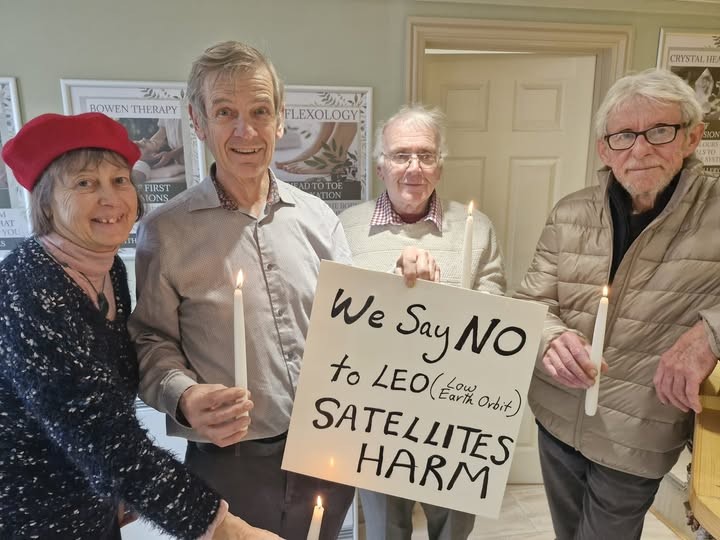
Above: Barnstaple residents call for an end to LEO satellites. Credit: Global Action to Stop 5G
North Devon resident and co-ordinator Tanja Rebel said: “The LEO satellites are one of the most serious and overarching environmental issues of all: they cause sky debris, harm the view of our night sky and disturb astronomical as well as weather observations through light pollution and electrosmog leakage.
“What’s more, they harm the ozone layer, the magnetosphere and the ionosphere - ie the electric circuit essential for all life on earth. The satellite launches also have a huge ecological footprint - in the air and on the ground - where new spaceports are destroying swathes of pristine areas - and they are blanketing the planet in electrosmog, which is not only disturbing meteorological and astronomical observations, but which is harmful to all biological life.
“To top it off, once complete, the satellites will form an inescapable planetary electronic surveillance grid.”
READ NEXT: New sections of North Devon coast path with a royal connection set to open
The campaigners are calling for an end to 5G and the forthcoming 6G, set to be rolled out around 2030.
They say there should be a return to hard-wired connections and point out the copper analogue landline works during a power cut and should be protected in UK law. They said it would be critical and important infrastructure during serious power cuts or cyber attacks.
Tanja added: “How can we rely on these satellites when we know that solar activity can and no doubt one day will cause complete havoc? Will we stand waving our phones in the air in the hope of a connection?”
READ NEXT: Are we heading for a white Christmas in Devon this year?
The group’s figures claim Starlink already has more than 9,400 operational satellites in orbit and that it aims to deploy up to 42,000 more.
Above: A message to ‘save our sky’ from Ilfracombe. Credit: Global Action to Stop 5G
They say Amazon’s Project Kuiper has 3,000 planned, China is planning up to 15,000, Eutelsat (OneWeb with 650 satellites already launched), the European Union (IRIS - 290 planned), Telesat (Lightspeed), Hanwha and various small commercial companies, notably in India, Japan and Canada.
A recent study by the Massachusetts Institute of Technology (MIT) found that in 2019 about 13,700 objects (including space junk) zoomed around the planet in low Earth orbit (LEO), at altitudes below 1,200 miles.

Above: Message from Mortehoe: ‘Join the throng to say NO to Elon Musk's LEO satellites, they are a danger to bird, bee, animal, you and me’.
It said that number has since risen to 24,185 objects in 2025, an increase of 76%. By the end of this decade, it is thought some 70,000 satellites may be in LEO.
The UK Health Security Agency (UKHSA) existing advice that exposure to radio waves from 5G base stations is well below set guidelines.
The UK government has said 5G poses no consequences for public health, although the UKSHA will continue to monitor the use of 5G and other radio wave technologies.

Subscribe or register today to discover more from DonegalLive.ie
Buy the e-paper of the Donegal Democrat, Donegal People's Press, Donegal Post and Inish Times here for instant access to Donegal's premier news titles.
Keep up with the latest news from Donegal with our daily newsletter featuring the most important stories of the day delivered to your inbox every evening at 5pm.